Hoot Back-End Delete Comment
Learning objective: By the end of this lesson, students will be able build a route that deletes embedded subdocuments inside a single hoot.
Overview
In this section, we will create a delete route to find and delete a single comment within a hoot.
We will be following these specs when building the route:
- CRUD Action: DELETE
- Method:
DELETE - Path:
/hoots/:hootId/comments/:commentId - Response: JSON
- Success Status Code:
200Ok - Success Response Body: A JSON status message.
- Error Status Code:
500Internal Server Error - Error Response Body: A JSON object with an error key and a message describing the error
Define the route
Our route will listen for DELETE requests on /hoots/:hootId/comments/:commentId:
DELETE /hoots/:hootId/comments/:commentId
Add the following to controllers/hoots.js:
// controllers/hoots.js

router.delete("/:hootId/comments/:commentId", verifyToken, async (req, res) => {
  // add route
});
🧠 This route might be seem intimidating at first. It requires both a
hootIdacommentId, so that we can locate both the parent, and then the child document within it.
❗ A user needs to be logged in to update a comment, so be sure to include the
verifyTokenmiddleware.
Code the controller function
Let’s breakdown what we’ll accomplish inside our controller function.
- First we call upon the
Hootmodel’sfindById()method. The retrievedhootis the parent document that holds an array ofcomments. We’ll need to remove a specific comment from this array.
To do so, we’ll make use of the MongooseArray.prototype.remove() method. This method is called on the array property of a document, and removes an embedded subdocument based on the provided query object ({ _id: req.params.commentId }).
- After removing the subdocument, we save the parent
hootdocument, and issue a JSON response with amessageofOk.
Add the following to controllers/hoots.js:
// controllers/hoots.js

router.delete("/:hootId/comments/:commentId", verifyToken, async (req, res) => {
  try {
    const hoot = await Hoot.findById(req.params.hootId);
    const comment = hoot.comments.id(req.params.commentId);

    // ensures the current user is the author of the comment
    if (comment.author.toString() !== req.user._id) {
      return res
        .status(403)
        .json({ message: "You are not authorized to edit this comment" });
    }

    hoot.comments.remove({ _id: req.params.commentId });
    await hoot.save();
    res.status(200).json({ message: "Comment deleted successfully" });
  } catch (err) {
    res.status(500).json({ err: err.message });
  }
});
Test the route in Postman
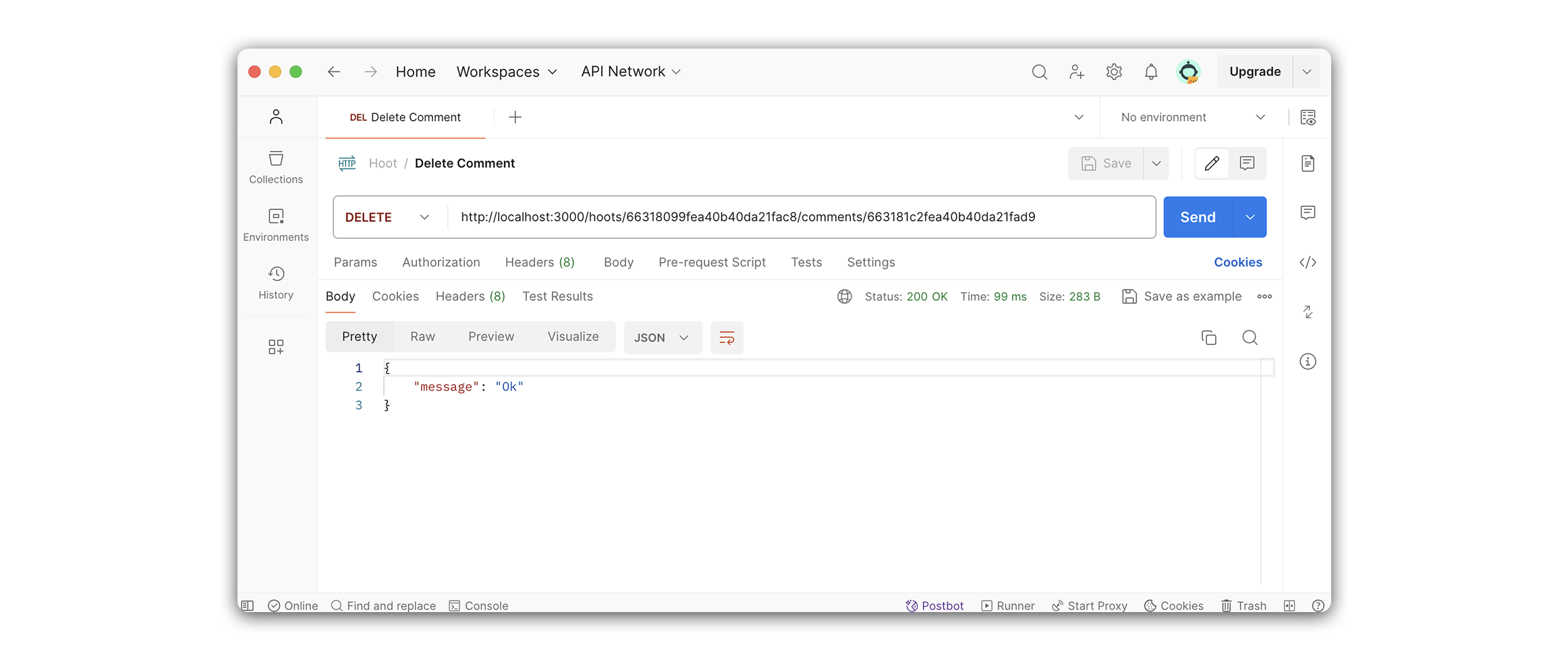
Now that we have finished the route let’s test it with Postman. We’ll do this by sending a DELETE request to /hoots/:hootId/comments/:commentId.
Create a new request in Postman. Let’s name this request Delete Comment and set its request type to DELETE. Your Postman URL should look something like this.
http://localhost:/hoots/63390dddff7c27bc4b86a1aa/comments/633915e08845c5a891cd4bf2
Your Postman request should look something like this:
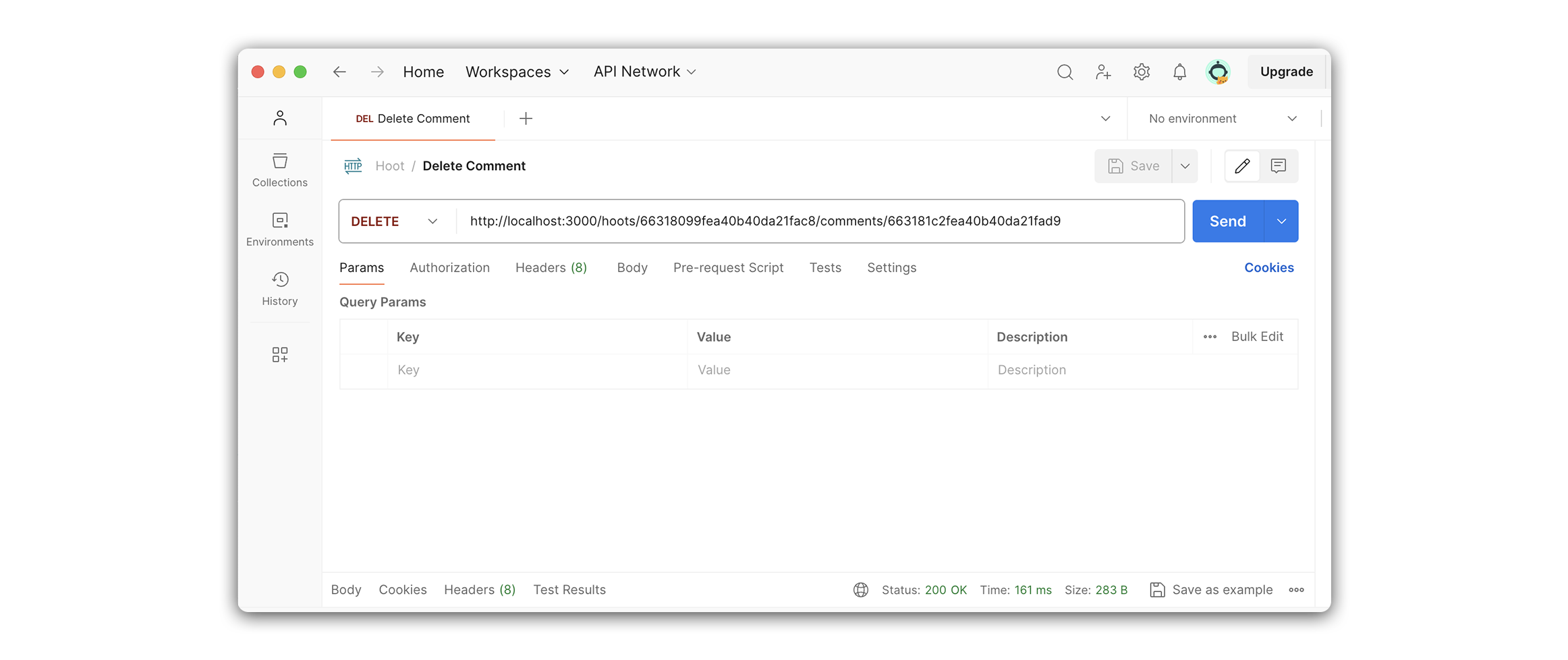
The response should be an object containing a message: "Comment deleted successfully" property: