Intro to Databases Comparing Relational and Non-Relational Databases
Learning Objective: This lesson will clarify the fundamental differences between relational and non-relational databases, helping students decide which to use based on specific application requirements.
Exploring the differences and use cases of different databases
While both relational and non-relational databases serve the purpose of persisting data, they do so using different methods.
Schema vs. schema-less databases
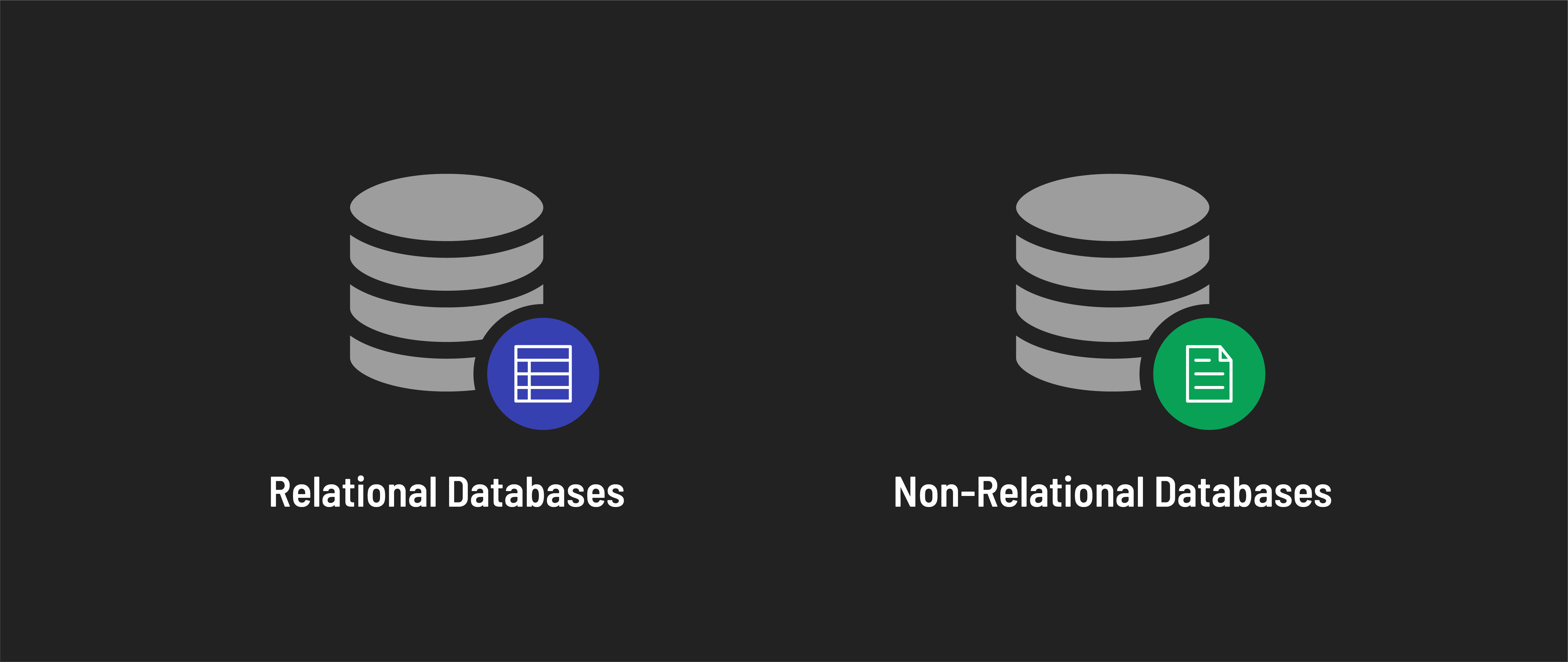
The core distinction between relational and non-relational databases lies in their approach to structuring data:
Schema in relational databases:
- A relational database uses a predefined schema to organize data into tables.
- Each table consists of rows and columns, where columns define the data type and structure.
- This rigid schema ensures consistent data entry and supports complex queries for data.
Schema-less in non-relational databases:
- Non-relational databases, like MongoDB, do not require a predefined schema.
- They allow dynamic data storage, supporting various data formats without needing a fixed structure.
- This flexibility is ideal for handling unstructured or semi-structured data and can quickly adapt to changes in application requirements.
Selecting the right database for your application
The choice between a relational or non-relational database largely depends on an application’s specific needs:
Relational databases for transaction-heavy applications:
- Relational databases are ideal for financial applications (for example, banking or stock trading) where handling database transactions with accuracy and consistency is paramount.
- These databases struggle with non-uniform data that cannot be neatly organized into structured tables.
Non-relational databases for unstructured data:
- These databases are suited for applications dealing with large amounts of diverse data, like social media platforms.
- MongoDB, a popular document-based non-relational database, offers high flexibility. It is a great choice for rapidly changing and evolving data models, as often seen in prototyping stages.