Intro to Databases Non-Relational Databases
Learning Objective: By the end of this lesson, students will understand the concept of non-relational databases, specifically focusing on MongoDB as an example.
What is a non-relational database?
Non-relational databases, commonly called NoSQL databases, break away from the traditional relational database model.
Instead of adhering to the fixed, table-based structure of relational databases, non-relational databases are designed to handle a variety of data models. These models are more flexible and can manage semi-structured or unstructured data efficiently.
Document-oriented databases
Among the types of NoSQL databases, document-oriented systems stand out for their versatility in managing data. MongoDB, a leading document-oriented database, exemplifies this approach. It is engineered to store, manage, and retrieve data as documents. These documents can be complex records with varying structures.
Understanding collections and documents in MongoDB
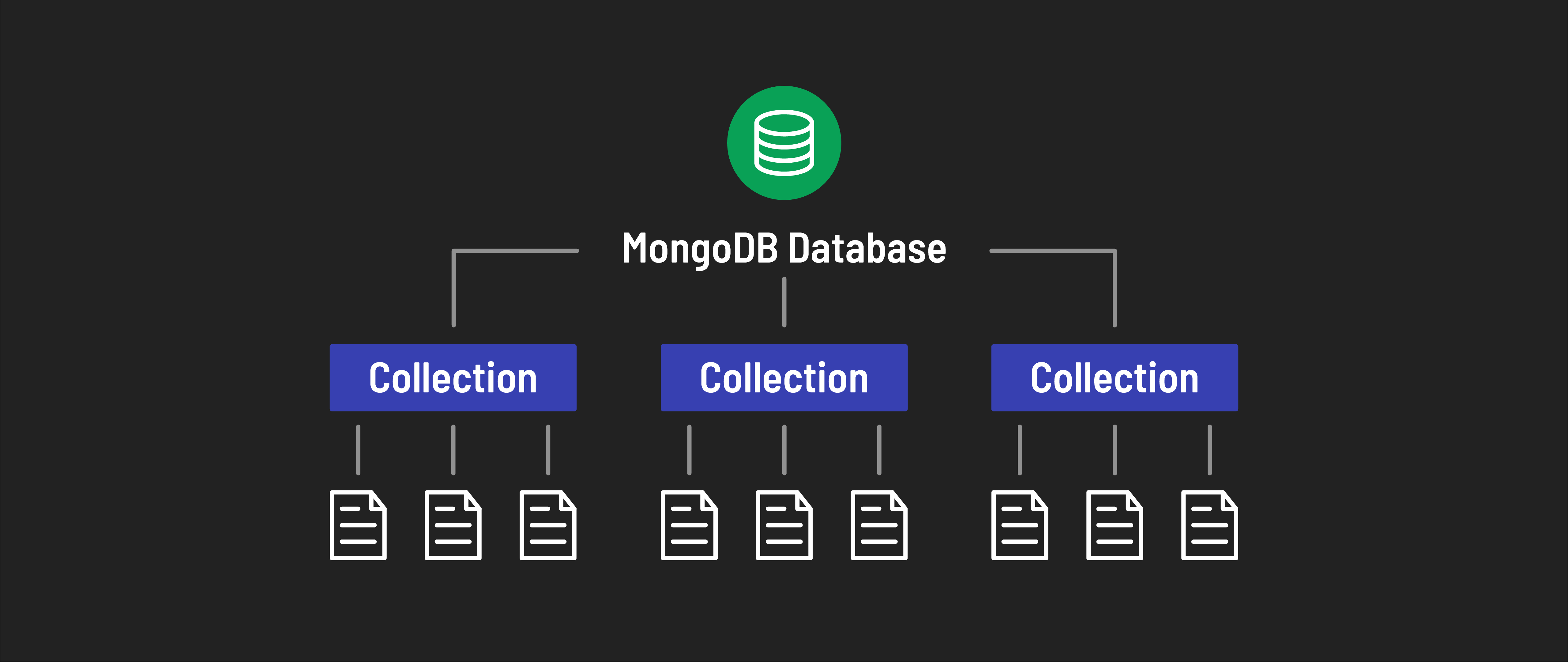
In MongoDB, data is stored as documents. These documents are similar to JSON objects and can contain a variety of key-value pairs. Documents are MongoDB’s basic unit of data, analogous to a row in a relational database. Instead of tables, documents are stored in collections.
📚 A collection is a group of related documents within a MongoDB database. Collections serve as a container for organizing and storing documents. A document is a single record within a collection.
Here’s an example of a MongoDB document:
{
  _id: ObjectId("65cfbe85aa84a57a40363ad5"),
  name: "Alex",
  role: "Developer",
  startDate: ISODate("2018-03-19T00:00:00Z"),
}