Intro to JavaScript Classes Inheritance
Learning objective: By the end of this lesson, students will understand the concept of inheritance in object-oriented programming.
What is inheritance?
In object-oriented programming, inheritance is a concept where a new class (known as a child or derived class) acquires, or inherits, attributes and behaviors (properties and methods) from an existing class (known as a parent or base class). This allows the child to use and, if necessary, modify or extend the functionalities of the parent class.
The newly derived class can be specialized by:
- Adding additional properties.
- Adding additional methods.
- Overriding existing methods.
📚 The newly derived class is called a derived or subclass while the original class is called a base or superclass.
A subclass automatically inherits all of the superclass’s properties and methods - whether you want them all or not.
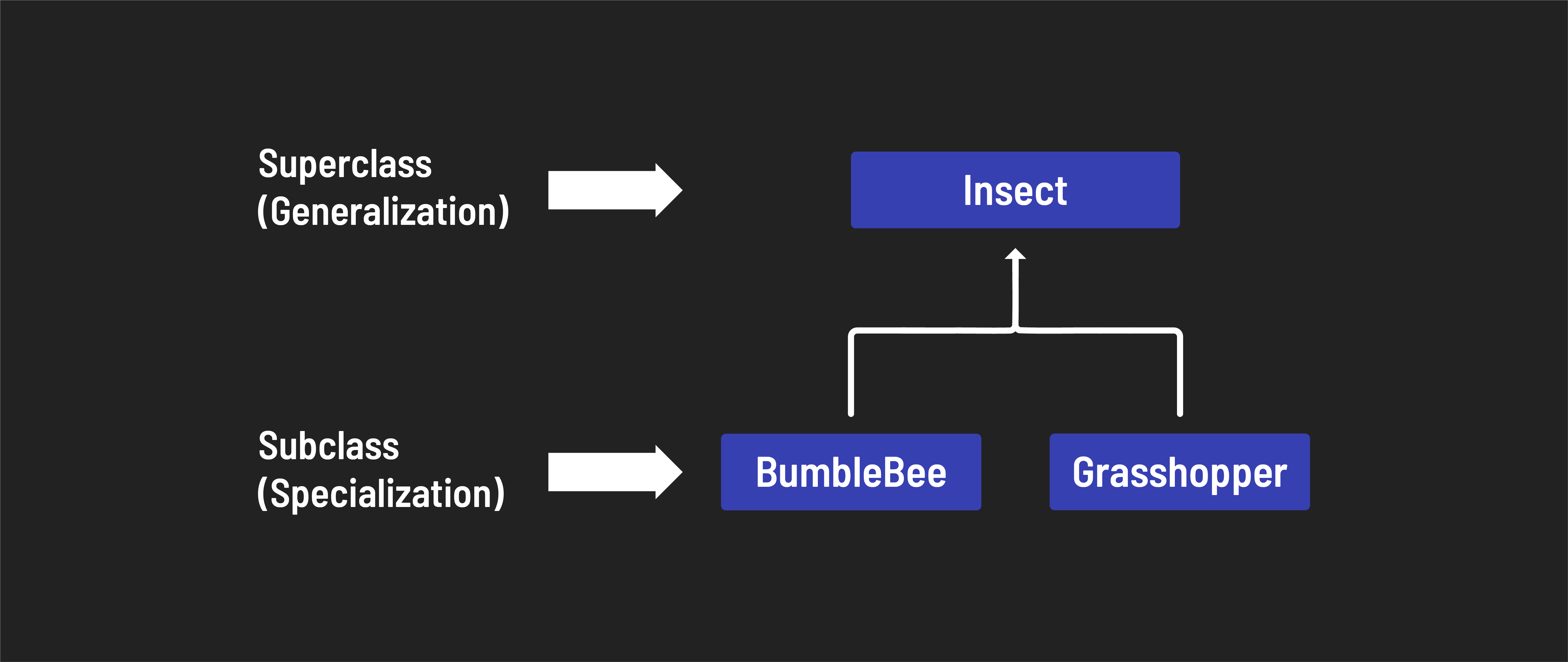
Above, the Insect superclass has the BumbleBee and Grasshopper subclasses derived from it.
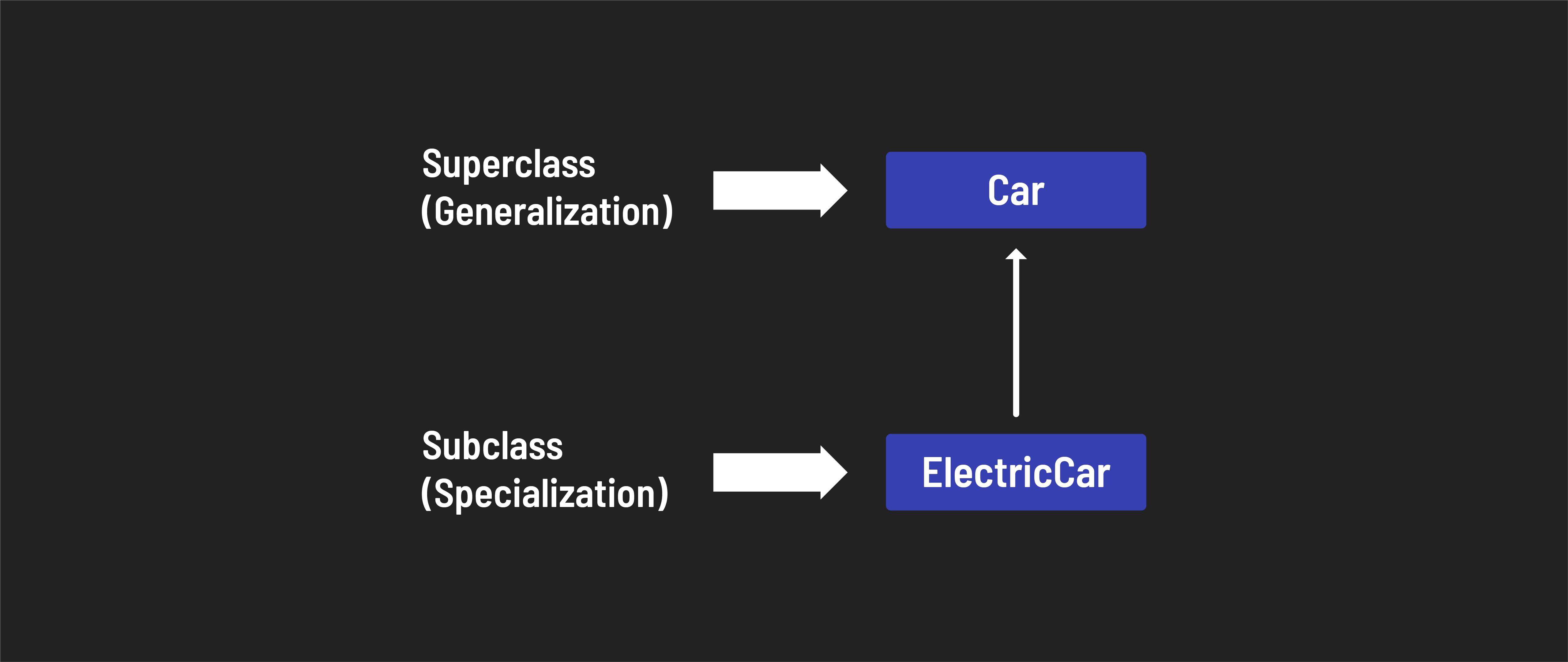
We’re going to add a subclass called ElectricCar that will be derived from the Car superclass! Here’s a diagram showing the relationship we will create.
Using the extends keyword to create a subclass
We use the extends keyword to define a subclass.
class ElectricCar extends Car {
  constructor(make, model, color, batteryCharge) {
    super(make, model, color);
    this.batteryCharge = batteryCharge;
  }
};
In a derived class, the super keyword represents the parent superclass and must be called before the this keyword can be used in the constructor. It can also be used to access properties of the superclass.
Additional properties like batteryCharge above can be initialized in the constructor. Instances of ElectricCar will have a batteryCharge property, while instances of Car will not. Let’s build an electric car!
const myVolvo = new ElectricCar('Volvo', 'EX30', 'Gray', 100); // Fully charged!
Determining which classes in a hierarchy to attach properties and methods to is difficult work, full of pitfalls and gotchas. This is one of the biggest hurdles to overcome when you’re getting started with inheritance - it won’t always be as clear-cut as it is above!
Overriding methods
A derived class can also override methods defined on the parent superclass. Let’s use this principle to modify the inherited start method for the ElectricCar class:
class ElectricCar extends Car {
  constructor(make, model, color, batteryCharge) {
    super(make, model, color);
    this.batteryCharge = batteryCharge;
  }
  start() {
    if (this.batteryCharge > 0) {
      this.isRunning = true;
      console.log('Your electric car is running!');
    } else {
      this.isRunning = false;
      console.log('Time to recharge!');
    };
  }
};
Next, we’ll start up the electric car, quickly deplete the battery, and try to restart it:
myVolvo.start() // "Your electric car is running!"
myVolvo.batteryCharge = 0
myVolvo.start() // "Time to recharge!"
Overriding prototype methods
In JavaScript, inheritance is a bit different compared to traditional object-oriented programming languages like Java or Python. In JavaScript, inheritance is based on prototypes rather than class-based hierarchies.
However, with the introduction of the class syntax in modern JavaScript, understanding prototypes isn’t as crucial for this lesson.
At the root of JavaScript’s inheritance hierarchy is the Object class. Almost every object in JavaScript is an instance of Object and inherits methods from Object.prototype.
For instance, the toString method is a common method that every object inherits:
const mySubaru = new Car('Subaru', 'Crosstrek', 'blue');

console.log(mySubaru.toString()); // "[object Object]"
This default toString method isn’t very descriptive, so often, you’ll want to override it to make it more useful.
For example, we can override Object’s implementation of toString by defining it in our Car class:
class Car {
  // the constructor will always be called
  constructor(make, model, color) {
    this.make = make;
    this.model = model;
    this.color = color;
    this.isRunning = false;
  }
  start() {
    this.isRunning = true;
    console.log('Running!');
  }
  static about() {
    console.log('I\'m the Car class!');
  }
  // override a prototype method
  toString() {
    return `This car is a ${this.color} ${this.make} ${this.model}.`;
  }
};
Now when we call the toString() method on mySubaru, we should see the defined output:
const mySubaru = new Car('Subaru', 'Crosstrek', 'blue');

console.log(mySubaru.toString()); // "This car is a blue Subaru Crosstrek"
So far, you’ve learned how to define a class that creates objects with properties and add prototype methods. This represents about 80% of what there is to know about classes - congrats!