Java Test-Driven Development What is Test-Driven Development?
Learning objective: By the end of this lesson, you’ll be able to:
- Define Test-Driven Develompent (TDD) methodology and explain its process flow.
- List TDD’s advantages over traditional testing methodology
- Describe how TDD supports Agile development processes.
What is Test-Driven development (TDD)?
While traditional software development methodologies work on the principle of Code first and then test, Test-Driven Development methodology inverts this principle as Test first and then you’ll know what to code.
| Aspect | Test-Driven Development | Traditional Software Development |
|---|---|---|
| Definition | A development methodology where tests are written before writing the actual code. | A development methodology where coding is done first, followed by testing. |
| Focus | Emphasis on ensuring functionality meets testable specifications early. | Emphasis on fulfilling requirements in the code and addressing issues later through testing. |
| Driving Factor | Driven by the need to pass predefined test cases. | Driven by the need to implement the requirements or features directly. |
| Approach | Iterative and incremental; encourages small development cycles. | Sequential and milestone-based; testing is often a separate phase. |
| Error Detection | Errors are forced to occur early and, hence, identified early. | Errors are detected only after full code development, during the testing phase. |
| Code Quality | Ensures cleaner, modular, and testable code from the start. | Higher risk of code quality degradation over time as fixing issues later may involve patching. |
| Test Coverage | Comprehensive, as tests are integral to development. | Risk of partial test coverage exists, subjected to effort overhead from defect identification, fixing and restesting. |
| Testing technique | Always automated. | Can be manual or automated. |
| Learning Curve | Requires developers’ skill building around writing automated test cases and test-driven principles as testing is prioritized over coding. | Easier to start, as coding is prioritized over testing. |
TDD process
Test-Driven Development follows a three-phase process:
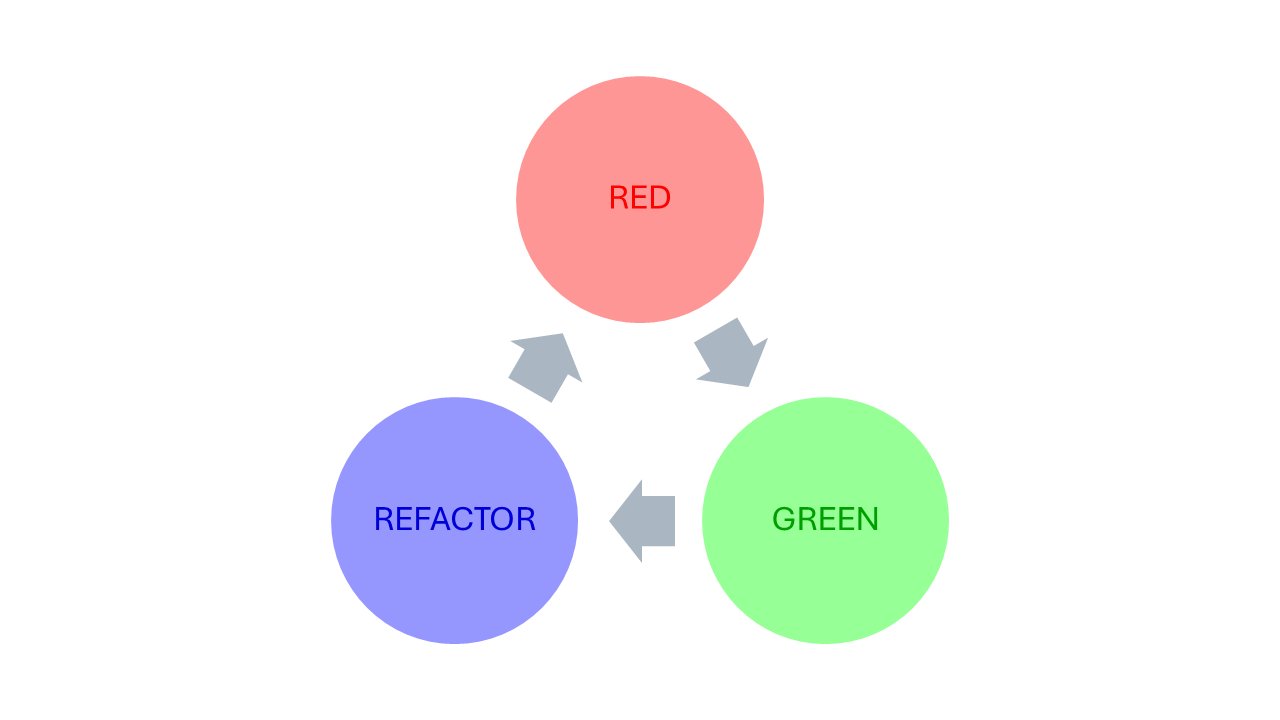
- Red: We write a failing test for the specific functionality (method) we’re about to implement. We do this using a unit testing automation framework like JUnit. This test should demonstrate that the desired behavior is not currently present in the code.
- Green: We, then, write the minimum amount of code necessary to make the failing test pass. The goal is to achieve a passing test, indicating that the new functionality has been successfully added.
- Refactor: Once the test passes, we refactor the code to improve its design and maintainability. This step ensures that the code remains clean and well-structured.
Then the process is iterated for the next functionality, until all the components, as per the requirement,
TDD and Agile methodology
| Agile principle | TDD’s role in fulfilling it |
|---|---|
| Delivering working software frequently. | TDD ensures each small iteration delivers fully functional and testable software. |
| Welcoming changing requirements. | TDD’s robust tests support changes by reducing risks associated with refactoring. |
| Prioritizing individuals and interactions over processes and tools. | Test writing involves close collaboration between business people and developers to clarify requirements and expectations. |
| Prioritizing working software over comprehensive documentation. | The automated tests serve as living documentation of the system and are always present with the source code. The software is always in a state that can be tested and verified. Each test describes a specific functionality, reducing the need for exhaustive upfront documentation. |
| Building projects around motivated individuals. | TDD empowers developers with confidence by providing immediate feedback on code quality. |
| Simplification. | TDD eliminates unnecessary coding by focusing only on what is required to pass tests. |
| Continuous attention to technical excellence. | TDD promotes clean, modular, and maintainable code. |
TDD comes into its own with pair programming approach. One developer can write and execute the unit test, and then allow the other developer to write the code to make the test pass.